Lost Circulation Is More Than a Drilling Problem
Lost circulation remains one of the most costly and unpredictable challenges in drilling operations. Whether drilling depleted reservoirs, naturally fractured formations, or highly permeable intervals, fluid losses can lead to significant non-productive time (NPT), increased mud costs, well control concerns, and operational delays.
The immediate objective is often clear: stop the losses as quickly as possible and continue drilling.
However, an equally important question is often overlooked:
What impact will the chosen solution have on the reservoir once drilling is complete?
Successfully drilling a well is important, but delivering a productive well is the ultimate objective.
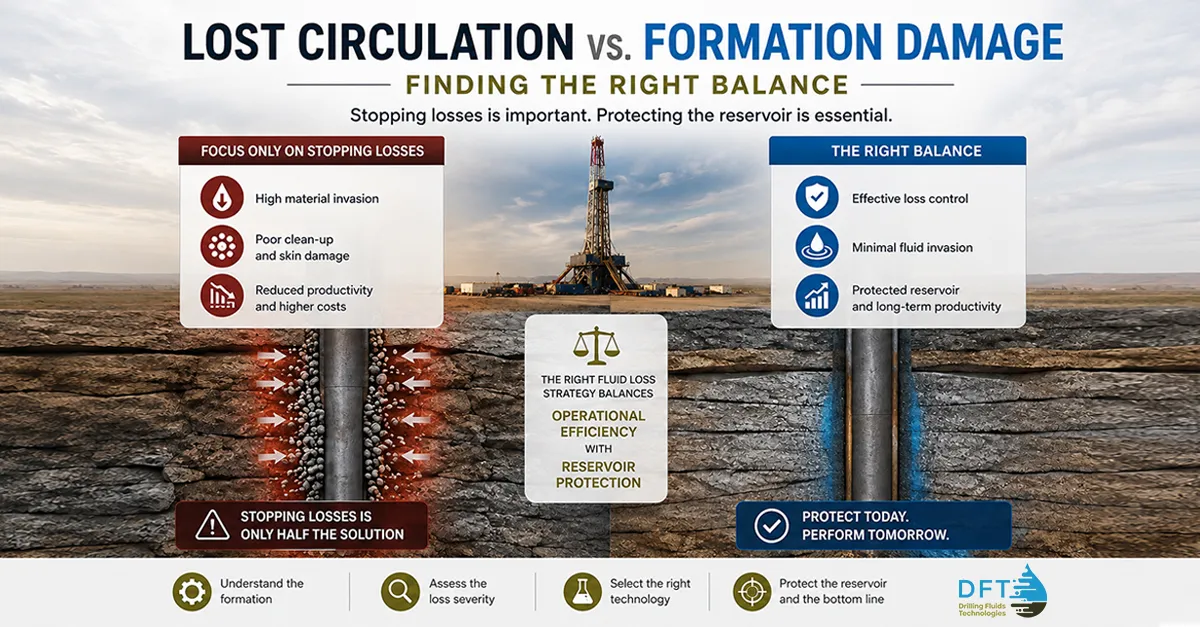
When Stopping Losses Creates New Challenges ?
Conventional lost circulation materials (LCMs) have played an essential role in drilling for decades. Fibers, flakes, granular materials, and blended systems continue to provide effective solutions for many applications and remain indispensable in the industry’s toolbox.
However, in production zones or reservoir sections, the strongest plug is not always the best solution.
Large volumes of bridging materials may effectively stop losses, but they can also penetrate productive formations, contribute to near-wellbore damage, complicate clean-up operations, and ultimately affect reservoir productivity if not properly selected for the application.
This is why today’s drilling strategies increasingly consider both immediate operational success and long-term reservoir performance.
Balancing Operational Efficiency with Reservoir Protection
Rather than asking, “How do we stop the losses?”, many operators now ask a more complete question:
“How do we control losses while protecting the reservoir?”
The answer depends on several factors, including:
- Reservoir characteristics
- Formation permeability
- Type and severity of losses
- Completion strategy
- Production objectives
Different challenges require different solutions, and selecting the appropriate loss-control method has become an important part of well planning rather than simply a reactive drilling decision.
Choosing the Right Technology for the Right Application
Modern drilling operations benefit from a wider range of technologies than ever before.
Conventional LCMs continue to provide excellent performance in many drilling scenarios, particularly where permanent or high-strength sealing is required.
For production intervals, however, operators may also consider technologies designed specifically to minimize long-term formation impact.
Acid-soluble loss control materials can provide effective sealing while allowing removal during completion or stimulation operations, helping preserve reservoir productivity.
Similarly, invasion-control drilling fluid technologies focus on reducing fluid invasion by creating a temporary pressure-balancing barrier at the formation face rather than relying solely on particulate bridging. This approach can help reduce losses while limiting filtrate invasion and supporting wellbore stability.
Selecting the appropriate technology should always be based on the well objectives, reservoir characteristics, and overall completion strategy.
A Smarter Approach to Loss Control
As wells become more complex and operators place greater emphasis on maximizing recovery, loss-control strategies are evolving beyond simply stopping fluid losses.
The goal is to maintain drilling efficiency while protecting the reservoir from unnecessary damage.
Solutions such as R-SEAL™, with its high acid solubility, are designed specifically for production zones where reservoir protection is a priority. Likewise, invasion-control systems such as AphronICS™ provide an alternative approach by helping control fluid invasion through temporary pressure balancing rather than conventional bridging alone as the fact that it is solid free system.
Both technologies illustrate an important shift in drilling philosophy: selecting solutions based not only on immediate operational performance but also on the long-term productivity of the well.
Conclusion
Lost circulation will always remain a major operational challenge, but the industry’s approach to managing it continues to evolve.
Rather than focusing solely on stopping losses, operators are increasingly considering how today’s drilling decisions will affect tomorrow’s production.
The most successful wells are those where drilling efficiency, wellbore stability, and reservoir protection are considered together. By selecting the right loss-control strategy for the specific application, operators can reduce non-productive time, minimize formation damage, and maximize long-term well performance.